Partial-exit payoff worksheet
Weight two assumed target exits, deduct a common R cost and compare a conditional break-even rate.
Price-level arithmetic and user-entered samples. A target ratio is neither a measured edge nor a guarantee of the stop fill.
Formula and assumptions
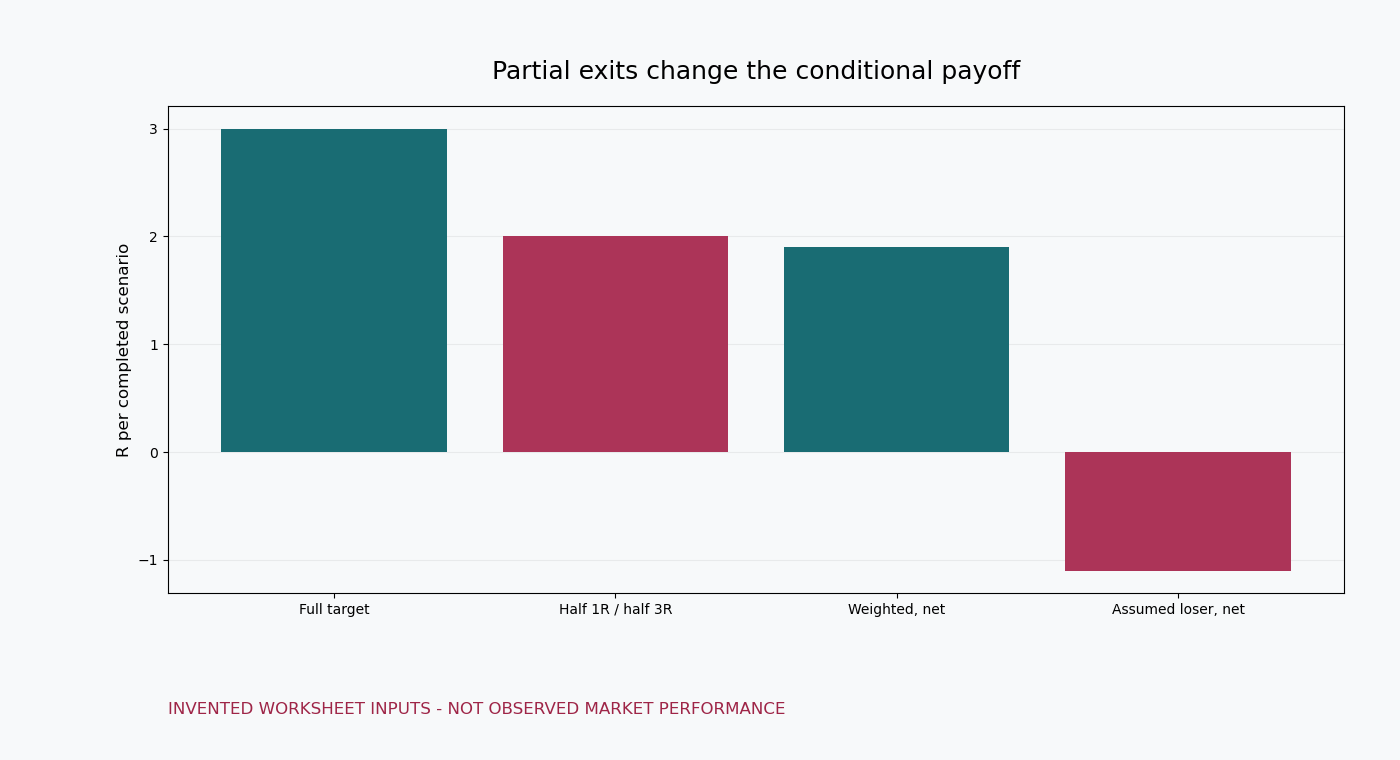
Gross winner R = first fraction x first target R + remaining fraction x second target R. Net winner subtracts cost; net loser adds cost. Break-even frequency = net loser / (gross winner + gross loser). The same cost is assumed on every outcome.
A two-outcome simplification
The entire winner path reaches both targets and the loser path reaches its stated loss. A first-target exit followed by a stopped remainder is a third outcome and is not silently assigned to either branch. Use the completed-outcomes analyser for a multi-outcome sample.
When the answer is not feasible
A cost greater than gross winner R can produce a break-even percentage above 100. That is a valid warning about these assumptions, not a probability. Fraction, costs and loss magnitude are invented inputs, not recommended trade settings.
Blank working records
Headers only. No observed trades, receipts or study findings are supplied in these templates.
Source documents
Documentation establishes the stated mechanism, not tested trading performance. Checked 9 October 2026; a later version can differ.
Preserve the original two-branch calculation
The earlier worksheet continues to weight two assumed winner targets in R, add the same extra R cost to its loser magnitude and subtract that cost from its winner. Its default weighted gross winner is 2R, net winner 1.9R and net loser 1.1R. The conditional break-even frequency is 1.1 divided by 3, or about 36.67%. The entered 40% winner assumption produces 0.1R net per completed branch. These are not observed frequencies. A first exit followed by a stopped remainder can be another outcome, which this two-branch simplification does not silently absorb into its winner.
A separate quantity path for a separate question
The new three-leg tool accepts original whole quantity, entry and stop references, exit quantities and prices, linear multiplier and additional total cash cost. It can reproduce a completed first-target-plus-stopped-remainder case without changing the earlier worksheet's R-branch contract. Exited quantities must fully reconcile; missing remainder is an invalid completed record. Original gross planned-risk denominator and extra-cost inclusion are explicit. The new example remains hypothetical and supplies neither probability weights nor a cash-funded account model. Preserve actual outcome categories and their sources rather than using a clean two-branch rate as a forecast or forcing all paths into two labels.