Tick size, linear multiplier and cash units
Keep minimum price increment separate from cash per point and whole position quantity.
Three different units
A tick size states a price increment. A cash-per-price-unit multiplier converts a linear price move into cash per position unit. Whole quantity states how many of those position units are involved. None should be silently substituted for another. If a hypothetical contract has tick size 0.25 and a multiplier of 50 cash units per full price point, one tick is 12.50 per contract. That does not establish the specification of a named current product. An actual account question needs the authoritative contract, quote convention, currency and applicable version before its price movement can be interpreted in cash.
Ratios can hide a cash mismatch
For entry 100, reference stop 98 and target 106, the clean price ratio is three regardless of a common positive linear multiplier. At multiplier one, four units have original gross risk eight. At multiplier 50, four have original gross risk 400. A separately supplied 20 cash fee has a different R consequence in those two records. Dividing raw prices gives the right amount ratio without identifying the cash exposure. The main price calculator therefore remains a common-price-unit tool, while the three-leg worksheet explicitly asks for a cash multiplier and whole quantity.
The filled multiplier specimen
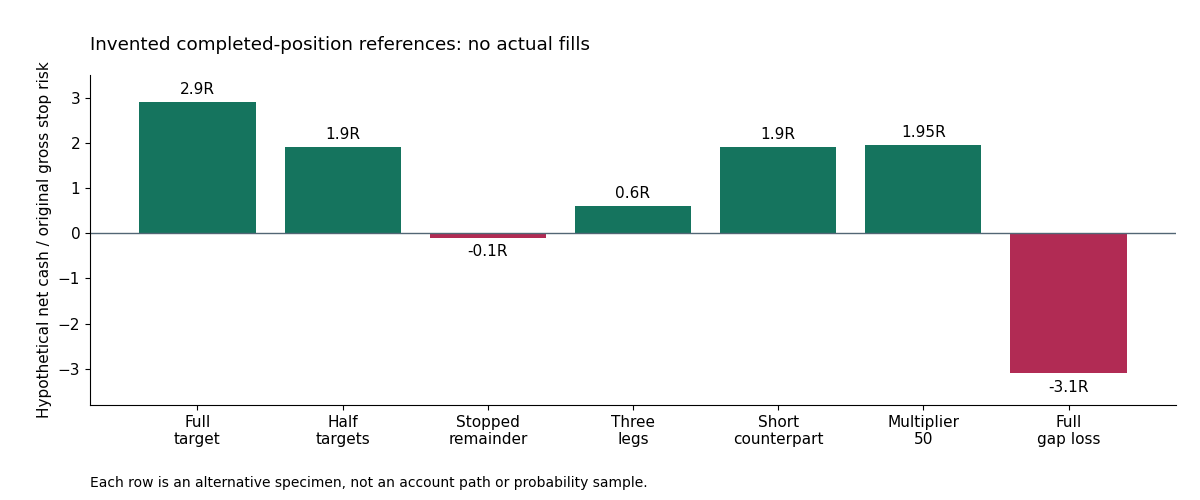
The workbook's invented multiplier case has four units, entry 100, stop reference 98, two exits at 102 and two at 106, multiplier 50 and additional cash cost 20. Gross cash contributions are 200 and 600, totalling 800. Original gross planned risk is 400, and net cash 780 gives 1.95R. These are not actual futures transactions, and the example supplies no margin amount or eligibility. A value of 50 is an assumed linear specification for the exercise, not a universal rule for a class of instruments or a recommendation to use four contracts.
Know where linear arithmetic ends
Options and other nonlinear claims cannot be priced from an underlying move times a constant multiplier alone. Currency conversion, financing, assignment, delivery, settlement and margin liquidation may require separate contracts and data. The new worksheet does not fetch those records or model them. It also does not enforce a live instrument's tick grid, because no instrument specification is selected. Rounding prices into a convenient grid after observing an outcome would change the producing record. Retain actual prices and declared specification identity in a real study, and report any unsupported cash or eligibility question as unresolved rather than accepting the ratio as complete financial evidence.
Completed invented payoff case
A fictional reviewer receives a tick size of 0.25 and cash multiplier 50 for an unnamed linear exercise. One tick is 12.50 per unit. Four units with two assumed exits at 102 and two at 106 earn 800 gross from entry 100; cost 20 leaves 780, or 1.95R on original risk 400. The source contains no actual product, margin agreement or fills. The calculation is complete only for its invented unit contract.
| Object | Record | Bounded finding |
|---|---|---|
| Tick assumption | 0.25 x 50 | 12.50 cash / unit |
| Original risk | 4 x 2 x 50 | 400 |
| Gross exits | 2 x 2 x 50 + 2 x 6 x 50 | 800 |
| Net completed R | (800 - 20) / 400 | 1.95R |
Primary references and scope
Expanded source review: 13 October 2026. Documentation supports the stated mechanism, not a tested account, hypothetical fill or provider outcome.