Risk and Reward After Adding to a Position
Reconcile quantity, original risk, revised stop assumptions and partial exits without letting a new denominator hide the old exposure.
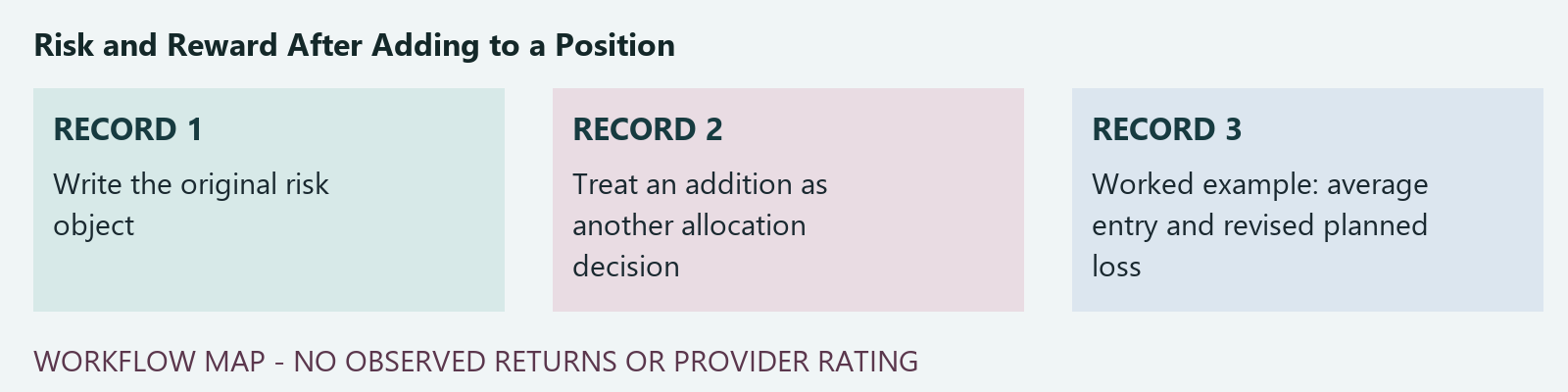
Write the original risk object
Record instrument, quantity, entry reference, stop assumption and the currency of planned loss. Define whether costs are included and whether the instrument is linear under the calculation. Intended stop distance is a planning input, not a guaranteed maximum loss. SEC order guidance provides execution context; contract terms and actual fills determine the account economics. Keep the original risk record intact when the position later changes. Otherwise a reported R multiple can describe a denominator selected after the outcome rather than the original decision.
Treat an addition as another allocation decision
Identify added quantity, entry, costs and the rule for changing the stop. A new average entry is a weighted price, not proof that risk became smaller. The added exposure may change the loss under the current stop, funding needs and concentration. Record the rationale before inspecting the final result. Do not infer an appropriate add-on size from a provider's conviction grade; account-level budgets and instrument specifications require their own declared inputs.
Worked example: average entry and revised planned loss
Invent a linear long position with ten units entered at 100 and a stop assumption at 98, giving 20 currency units of gross planned loss. Add five units at 102 while leaving that stop assumption unchanged. The weighted entry becomes 100.6667 and the total planned loss at 98 becomes 40: twenty on the first lot plus twenty on the addition. Relative to the original 20-unit denominator, current planned exposure is 2R. This is hypothetical arithmetic before costs, gaps or fill uncertainty, not a safe-loss guarantee.
Keep realised and remaining quantities separate
A partial exit creates realised proceeds while leaving a remaining position with its own exposure. Record the exact lot convention used for cost basis, quantity and fees. Do not count the exit as a complete trade and then count the residual as a new independent winner without a stated grouping rule. The provider's raw model convention can differ from account accounting; both need clear labels. A chart showing the target touched cannot establish the quantity filled or the price of each partial close.
Compare denominators without switching mid-report
Original planned risk, current planned stop loss, capital employed and marked equity answer different questions. Report which one defines R or percentage return. If stop assumptions changed, preserve both versions and the time of the decision. Dividing a final gain by a much smaller late-stage risk value can produce an impressive ratio while concealing earlier exposure. Show the original-denominator outcome and the full allocation sequence instead of letting one adjusted headline replace the history.
Use the worksheet as a reconciliation
Enter each allocation event, its planned loss contribution and actual account evidence if available. Keep costs, conversion and unexecuted orders separate from pure price-distance arithmetic. If fills or instrument units are absent, do not publish a reconstructed account result. This chapter extends reward-to-risk reasoning beyond a static calculator without recommending a scale-in strategy. Its useful conclusion is whether the reported denominator stayed faithful to the stated question, not whether adding to a position improves expected performance or is suitable for a particular account.
Decision record
| Question | Record to retain | Decision boundary |
|---|---|---|
| Initial risk | Original quantity, reference, stop assumption and costs | Planned stop loss is not a hard account-loss bound |
| Addition | New quantity, entry and allocation time | Weighted entry alone does not describe total risk |
| Partial close | Filled quantity, lot basis and remaining exposure | A partial event is not automatically an independent trade |
| Reported R | Frozen denominator and full event sequence | Do not replace original risk after observing the result |
Blank working record
The worksheet contains column headings only. Enter your own dated observations, keep absent evidence marked unknown, and do not treat the file as certification.
 Download worksheet (CSV)
Primary references
These documents support mechanisms and source definitions, not a tested trading result or a recommendation. Accessed 9 October 2026. The decision workflow and invented examples above are editorial exercises.
Keep reading
Publication methodology | Working glossary | Source and correction policy
Do not retrofit the single-entry worksheet
The new calculator models one declared original entry and three complete exits. It is not a scale-in risk-policy engine. Multiple entries need an explicit effective risk rule, original risk additions and their own transaction identities before a complete denominator can be reconstructed. The existing scale-in protocol and worksheet remain the appropriate place to record those questions. Supplying a weighted entry alone does not establish a maximum simultaneous risk or an account allocation policy. No later exit result is used to rewrite the entry identity, choose a prettier denominator or alter a proprietary production exit owner.